
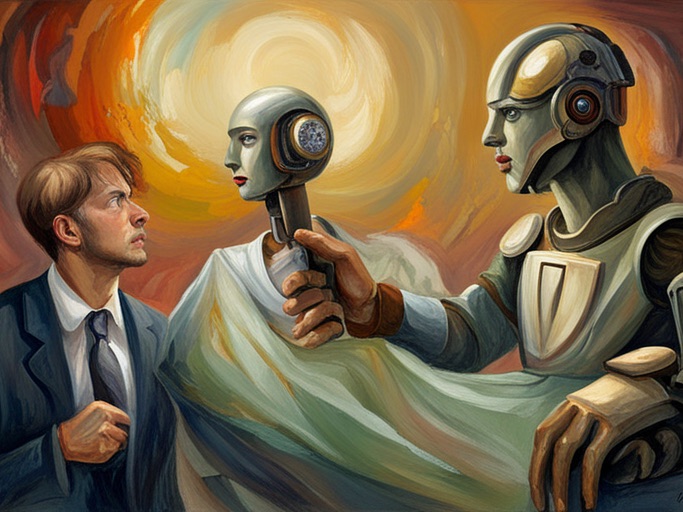
Here you can learn why AI cannot replace experienced professional speakers and what it fails at.
The role of creativity in speech
Human language is an extraordinarily complex and diverse means of communication. It goes far beyond the mere transmission of information and allows us to express a wealth of emotions, impressions, and ideas. Humor, dialects, genuine emotions, and imitation of others are all part of the creative repertoire of human voices. These aspects make the spoken word a vivid, individual expression of human creativity.
AI and the spoken word
As technology has advanced, AI systems have demonstrated impressive capabilities in speech recognition and synthesis. They can imitate human voices, convert text into spoken language, and AI can even generate complex sentences itself. But there are limitations. Despite advances, AI cannot replicate the unique human ability to perform creative and expressive speech.
The limitations of AI in terms of speaking skills.
1. AI lacks the ability to generate genuine emotion and feeling in speech. Emotional intelligence and empathy are essential components of human communication, and their representation in spoken language goes far beyond word choice.
2. AI cannot respond to context with the same flexibility and spontaneity that a human speaker can. The ability to spontaneously adapt tone, style, and emphasis to context and listeners comes naturally to humans, but is an enormous challenge for AI.
3. AI lacks the cultural understanding and life experience that human speakers bring to their performance. Dialects, regional accents, and culturally specific phrases or humor are difficult for AI to master.
The human element: audio example by Hans-Jörg Karrenbrock
For a concrete example, consider professional voice actor Hans-Jörg Karrenbrock, who has been heard in thousands of TV and radio productions, films and video games for over 35 years. He impressively demonstrates the range and versatility that a human voice actor can achieve. With his wide range of pitches, his humor, his ability to do word acrobatics, and his perfect timing, he is an example of how far AI is from mastering human speaking skills.
Here Hans-Jörg Karrenbrock shows his creativity - in action for Audiobird
For comparison: Google Text to Speech in Action (German, Neural2, de-Neural2-B, Speed 0.96; Pich -4.00)
What Text to Speech AI can't do:
- Real emotions
- Humor
- Different moods of a speaker
- Understanding the pronunciation of foreign words
- Dialects & cultural understanding
- Understanding and interpreting
- Vocal nuance
- Situational Awareness
- Life experience
The philosophy of understanding and the role of language.
The importance of language and understanding in this context can be further clarified by the philosophy of Hans-Georg Gadamer, a prominent exponent of hermeneutics. For Gadamer, language is not merely a tool for transmitting information, but a medium and framework of understanding itself. It is a living and dynamic phenomenon shaped by human experience and context. Meanings and understandings unfold in dialogue and exchange. This underscores the complexity and subtlety of the spoken word, which AI systems cannot yet and may never fully encompass. This is not just about correct syntax or semantics, but also about the interpersonal and cultural dimensions of language.
The preference for human-spoken audio books.
Amidst the discussion of AI and human speakers, a simple but important preference emerges: many people prefer to hear audiobooks read aloud by real people. The reason for this lies in the subtle nuances and emotionality that a human narrator brings to the narrative.
The human voice can convey warmth, humor, suspense, sadness, and a host of other emotions that enrich the audiobook experience. The dynamics and variability of human voices draw us into the story and make us empathize with the characters. The ability to adjust tone, add emphasis, or convey a character’s mood through voice makes the audiobook lively and authentic.
Additionally, a human narrator allows for a personal connection that an AI cannot. When we listen to a human voice, we feel connected to the narrator, making the audiobook experience more personal and human.
Despite all the technological advances, AI still has a long way to go before it can fully replicate the complexity and depth of the human voice and expression. Until then, we will continue to enjoy the pleasures of audiobooks, movies, and podcasts brought to life by accomplished human voice actors.
The bottom line: the irreplaceability of human speech.
Advances in AI are impressive, and it will undoubtedly continue to make important contributions in many fields. But the creative and expressive potential of human speech or singing remains an area so far beyond the reach of AI. Human speakers, like Hans-Jörg Karrenbrock, remain indispensable for all kinds of media and communication projects where the ability to evoke profound emotions and creatively convey complex ideas is key.