The video is 60 seconds long, the script has 210 words – and it is only during recording that the problem becomes clear: it does not fit. The result is a rushed delivery, cuts or extra production work. Yet the length of a voiceover script can be estimated fairly accurately in advance. This guide gives you the key benchmarks and a quick check for your script.
The rule of thumb: 2 to 2.5 words per second
For German-language voiceovers, a benchmark of around 120 to 150 words per minute has proved useful. That equates to roughly 2 to 2.5 words per second. Where your script should sit within this range depends on the format:
Speaking pace | Words per minute | Typical formats |
|---|---|---|
Relaxed | 110–125 | Corporate image video, audio guide, emotionally engaging brand films |
Moderate | 125–140 | Explainer video, e-learning, telephone announcement |
Brisk | 140–160 | Commercial, social media clip, promo |
Important: these are practical benchmarks, not fixed standards. Every voice has its own pace, and a script with lots of technical terms needs more time than a casual conversation.
Benchmarks by running time
The following table assumes a moderate pace of 125 to 145 words per minute. It is a useful starting point for most corporate and advertising formats.
Running time | Word count (guideline) | Example |
|---|---|---|
15 seconds | 30–35 | Social ad, bumper ad |
20 seconds | 40–50 | Short radio commercial, telephone announcement |
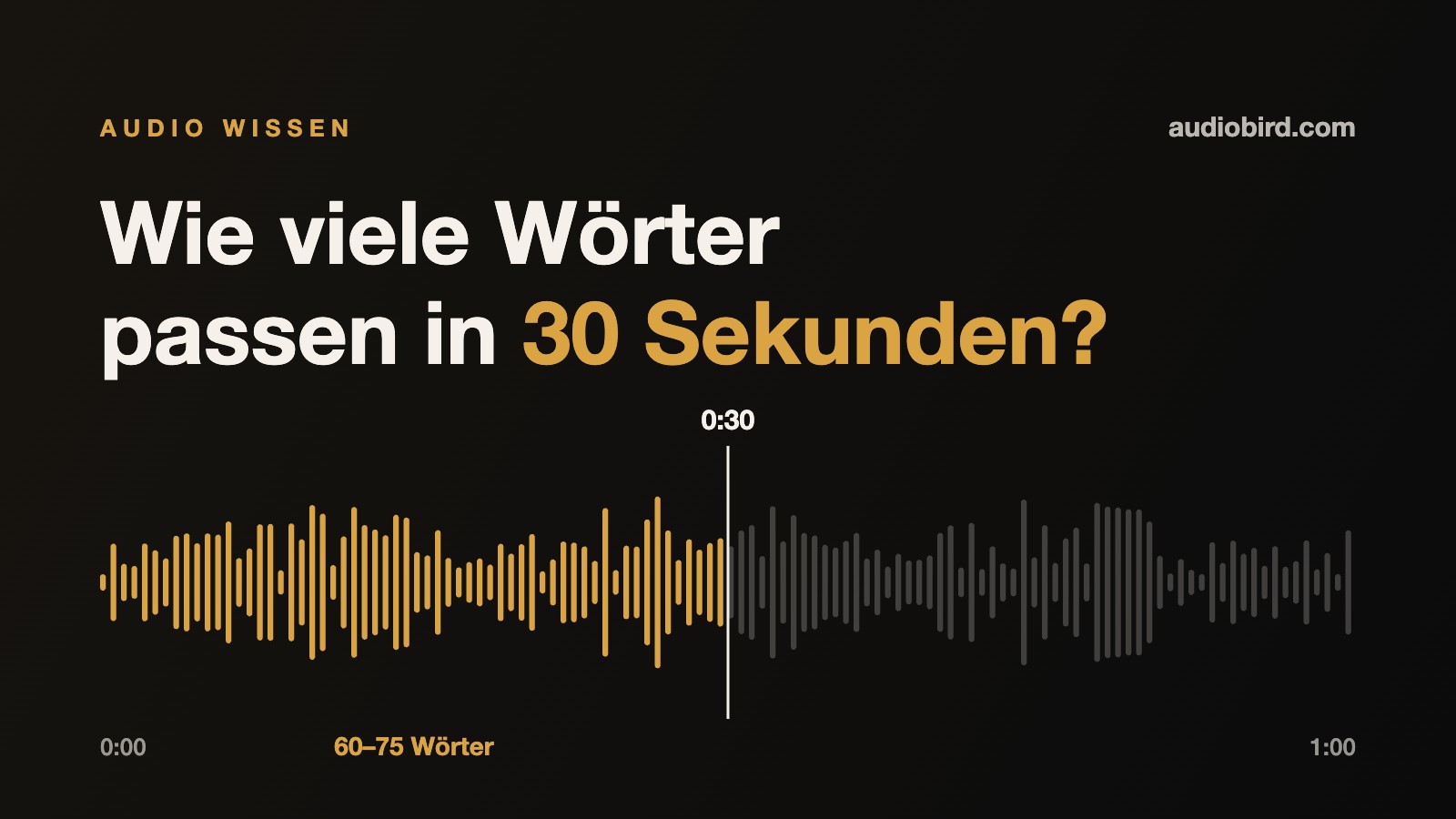
30 seconds | 60–75 | Standard radio or online commercial |
60 seconds | 125–145 | Product video, short explainer video |
90 seconds | 190–220 | Explainer video |
2 minutes | 250–290 | Corporate image video |
3 minutes | 375–435 | E-learning module, corporate film |
What can throw off the calculation
The word count alone tells only half the story. These factors make a script take longer without showing up in the count:
Numbers and abbreviations: “€1,299” counts as one word, but takes six to say in German. “24/7”, web addresses and telephone numbers also take much longer to say than they might appear to.
Long compound words: The German word “Datenschutzgrundverordnung” (General Data Protection Regulation) is a single word with eight syllables. For technical scripts, it is worth estimating syllables rather than words.
Product and brand names: Names in other languages or those that need clarification are spoken more slowly and clearly.
Pauses, music and sound effects: A sonic logo at the end, a breath before the punchline, two seconds of music at the start – all of these reduce the time available for speech.
Mandatory information: Legal disclaimers at the end of a commercial must remain intelligible and should be factored in from the outset.
Matching words to visuals: leave some breathing room
In videos, the voiceover should not fill the entire running time. A useful guideline is to limit speech to around 80 to 85 per cent of the video's length at most. This leaves room for visual transitions, musical accents and moments when the visuals speak for themselves. A 60-second video would therefore be closer to 105 to 125 words than 145.
The five-minute check for your script
Count the words. Only count the spoken text – not direction notes or scene descriptions.
Write out numbers. Write prices, years and abbreviations as they will be spoken. Only then will the count be accurate.
Read aloud and time yourself. Read the script at the pace you want for the finished audio – not silently in your head, as silent reading is much faster.
Allow a ten per cent buffer. Professional voice artists add emphasis and pauses that are often missing when you do your own read-through.
Cut rather than speed up. If the script does not fit, remove content. A rushed delivery compromises clarity and impact.
Different languages, different lengths
If you have a script translated, check its length again. English versions are usually shorter than the German original, while French and Spanish versions are often closer to the German length. If a language version needs to fit an existing video, each version must be timed individually to the visuals – ideally during translation, not only once you reach the studio.
What script length means for your budget
With AI voices, the relationship is direct: Audiobird charges by word count, currently at €0.05 per word (net). A 70-word script therefore costs €3.50. You can find suitable voices among the AI Artists, and current rates in the pricing overview.
With real voice artists, the price depends less on word count than on how the recording will be used: a commercial running as a paid ad is priced differently from an internal training video. The fee calculator provides an initial guide.
Conclusion
Allow 2 to 2.5 words per second, write out numbers, read aloud with a stopwatch and give your script room to breathe. If you are unsure whether your script fits the planned running time and your preferred voice, describe your project in the Audiobird Agent: it will suggest suitable real voices and AI voices, complete with audio samples.